Thursday, March 24, 2011

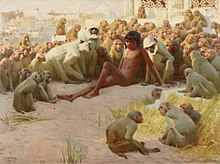
The Monkey People


Road Song of the Bandar Log (the Monkey People)
by Rudyard Kipling

Here we go in a flung festoon,
Half-way up to the jealous moon!
Don’t you envy our pranceful bands?
Don’t you wish you had extra hands?
Wouldn’t you like if your tails were–so–
Curved in the shape of a Cupid’s bow?
Now you’re angry, but–never mind,
Brother, thy tail hangs down behind!

Here we sit in a branchy row,
Thinking of beautiful things we know;
Dreaming of deeds that we mean to do,
All complete, in a minute or two–
Something noble and wise and good,
Done by merely wishing we could.
We’ve forgotten, but–never mind,
Brother, thy tail hangs down behind!

All the talk we ever have heard
Uttered by bat or beast or bird–
Hide or fin or scale or feather–
Jabber it quickly and all together!
Excellent! Wonderful! Once again!

Now we are talking just like men!
Let’s pretend we are … never mind,
Brother, thy tail hangs down behind!
This is the way of the Monkey-kind.

Then join our leaping lines that scumfish through the pines,
That rocket by where, light and high, the wild grape swings.
By the rubbish in our wake, and the noble noise we make,
Be sure, be sure, we’re going to do some splendid things!

Monday, March 7, 2011

Vaccines not responsible for Autism, part 14

My first big splash in the blogosphere will have occurred five years ago in June, when I first discovered the utter wingnuttery that is Robert F. Kennedy, Jr. It was then that I wrote a little bit of that not-so-Respectful Insolence that you've come to know and love entitled Salon.com flushes its credibility down the toilet, a perfect description of an article by RFK, Jr. published in Salon.com and simultaneously in Rolling Stone entitled Deadly Immunity. As I look back, I realize that, as widely linked to and discussed as it was at the time, that post, arguably more than any other, was the one that established me as one of the go-to bloggers when it came to vaccines. Of course, it may also have been the gloriously Orac-ian verbiage I employed. As longtime readers may (or may not) recall, at the time, I referred to RFK's article as the "biggest, steamingest, drippiest turd I've ever seen it [Salon.com] publish, an article so mindnumbingly one-sided and uncritical that in my eyes it utterly destroys nearly all credibility Salon.com has had as a source of reliable news and comment." Nothing in the five years since then has changed my assessment of RFK, Jr.'s investigative prowess. Indeed, if anything, he's gotten worse, such as the time he tried to out-crank CBS News' resident antivaccine propagandist Sharyl Attkisson (who has been in bed with someone at Age of Autism to coordinate counterattacks on its enemies) or the time he teamed up with David Kirby and Generation Rescue to cube the stupidity.

That was over a year ago, and since then RFK, Jr. has been fairly quiet, at least on the vaccine front. Maybe it had something to do with his being ignored by the then-new Obama administration when his supporters lobbied very hard to get him appointed to head the EPA. Or maybe it was embarrassment at having so successfully cubed the stupid. Who knows?

Whatever the reason for his year-long disappearance from the anti-vaccine fray, it would appear that he's been pulled out of storage, dusted off, and sent once again to tilt at mercury windmills. It feels like 2005 all over again. That's because RFK, Jr. has laid yet another one of his steamy, drippy, corn-textured turds on the blogosphere as only he can in the one place where such a stench of bad arguments and pseudoscience can go completely unnoticed among all the other turds that routinely drip from it. That's right, RFK, Jr. has reappeared on that bastion of anti-vaccine pseudoscience, The Huffington Post, and the title of his latest turd is Central Figure in CDC Vaccine Cover-Up Absconds With $2M. In what appears to be an obviously coordinated attack, Generation Rescue's anti-vaccine crank blog Age of Autism is promoting RFK, Jr.'s article and adding a few of its own with titles such as Poul Thorsen's Mutating Resume by the not-so-dynamic duo of fact-challenged anti-vaccine propagandists Mark "Not a Doctor, Not a Scientist" Blaxill and Dan "Why can't I find those autistic Amish?" Olmsted and NBC 11 Atlanta Reports: Vaccine Researcher Flees with $2M, featuring this news report:

http://bcove.me/xd3jkg6t

Looks like the mercury militia got to another reporter. There's Lyn Redwood spewing misinformation and nonsense hither, thither, and yon.

So what's going on here? Let's look at RFK's article and how he starts it:

A central figure behind the Center for Disease Control's (CDC) claims disputing the link between vaccines and autism and other neurological disorders has disappeared after officials discovered massive fraud involving the theft of millions in taxpayer dollars. Danish police are investigating Dr. Poul Thorsen, who has vanished along with almost $2 million that he had supposedly spent on research.
Thorsen was a leading member of a Danish research group that wrote several key studies supporting CDC's claims that the MMR vaccine and mercury-laden vaccines were safe for children. Thorsen's 2003 Danish study reported a 20-fold increase in autism in Denmark after that country banned mercury based preservatives in its vaccines. His study concluded that mercury could therefore not be the culprit behind the autism epidemic.


You know, either heaven shines on them or the anti-vaccine movement must be the luckiest bunch of pseudoscientists in the world. Here it is, a mere couple of weeks after Andrew Wakefield's fall was complete, after he had, in rapid succession, been found guilty of research misconduct by the General Medical Council in the U.K.; had his pride and joy retracted from the scientific literature, his 1998 Lancet paper claiming a link between the MMR vaccine and "autistic enterocolitis," a paper that, with the help of Wakefield himself and the credulous, scandal mongering U.K. press, sparked a fear of the MMR vaccine that persists 12 years later and has resulted in MMR uptake rates plummeting; had his most recent pride and joy, an unethical bit of bad science in which he subjected baby Macaque monkeys to experimentation all in the name of "proving" that the hepatitis B vaccine causes autism and/or neurological damage withdrawn from the literature; and been ignominiously forced to resign from Thoughtful House by, of all people, Jane Johnson, heiress to the J&J pharmaceutical fortune. The result has been some truly tinfoil hat worthy conspiracy mongering from Age of Autism and Jenny McCarthy herself. And what happens? There's a vaccine scientist who appears as though he may have absconded with as much as $2 million dollars, giving Generation Rescue and the anti-vaccine crankosphere an opportunity to go full mental jacket putting a face to vaccine scientists that they could attack. As Paul Offit knows, that's what the anti-vaccine movement does best. (Certainly it's not science that it does best.)

But was Thorsen really the driving force behind the Danish vaccine-autism studies that the anti-vaccine movement hates so much? I've been paying close attention to the vaccine-mercury-autism manufactroversy for nearly five years now, and I've never heard of him, although I had heard of one of his coauthors. If Thorsen was so important to the pro-vaccine movement, you wouldn't know it from the two studies that the mercury militia is hoping to discredit by turning up its propaganda machine to 11 about Thorsen's possible criminal behavior. Those papers are:

Madsen KM, Hviid A, Vestergaard M, Schendel D, Wohlfahrt J, Thorsen P, Olsen J, Melbye M. A population-based study of measles, mumps, and rubella vaccination and autism. N Engl J Med. 2002 Nov 7;347(19):1477-82.
Madsen KM, Lauritsen MB, Pedersen CB, Thorsen P, Plesner AM, Andersen PH, Mortensen PB. Thimerosal and the occurrence of autism: negative ecological evidence from Danish population-based data. Pediatrics. 2003 Sep;112(3 Pt 1):604-6.
It is the Pediatrics paper that the mercury militia appears to be concentrating mostly on because it directly deals with thimerosal in vaccines. But look at the citations above for both papers anyway. Do you notice something? Look where Thorsen's name is in the list of authors in both studies. Notice that it is not first, nor is it last. This is important because author order matters in scientific and medical studies. In straight science studies, the two most important authors are usually the first author and the last author. The last author is usually the senior author in whose laboratory the work was done, while the first author is the person whose project the work represents and who was the primary author of the manuscript. In medical papers, as in Pediatrics or NEJM, the author list usually signifies the relative contribution of each author to the article, the first being the most important and the last being the least important. In both types of articles, there is always designated one author who is the corresponding author. In scientific papers, the corresponding author is almost always the last author; in medical papers it is usually the first author. The corresponding author is responsible for answering inquiries about the study and, way back in the age before PDF files, used to be the author to contact to request reprints. Not only that, the corresponding author is generally considered to be the primary author for the paper.

Notice something else?

That's right. Poul Thorsen is not the first author for either of these studies. He is not the last author, either. He is not the corresponding author; that would be Kreesten M. Madsen, MD, who was corresponding author on both the NEJM and Pediatrics papers. As it turns out, Thorsen is safely ensconced in the middle of the pack of co-authors. That's why, when RFK, Jr. refers to the Pediatrics study as "Thorsen's study," he is either grossly ignorant or outright lying. (Take your pick.) Anyone who knows anything about how the scientific literature works would be able to spot that immediately just by looking at the abstracts of these articles. Trust me, if studies this large really were Thorsen's babies his name would not have been relegated to fourth or sixth on the list of authors. Basically, Thorsen's position in the author lists of these two papers indicates that, whatever leadership position he may have held at Aarhus University and in its vaccine studies group, he clearly was not the primary contributor for these studies, and they were not his studies primarily.

Not that that stops the mercury militia from going out of its way to paint him as such, referring to him as a "central figure." I have to tip my hat to RFK, Jr. his language throughout his article is truly Orwellian, a propaganda masterpiece of prestidigitation of language and innuendo. Here are just a few examples of perfectly loaded phrases sprinkled throughout the article, all designed to suggest concealment and conspiracy:

..."built a research empire..."
"...failed to disclose..."
"...has disappeared..."
"...damning e-mails surfaced..."
"...culprit behind..."
"...leading independent scientists have accused CDC of concealing the clear link between the dramatic increases in mercury-laced child vaccinations."
"...safe to inject young children with mercury..."
"...CDC officials intent on fraudulently cherry picking..."
RFK, Jr. also parrots anti-vaccine lies about the study that were hoary back when David Kirby first published the mercury militia Bible, Evidence of Harm, lies like:

His study has long been criticized as fraudulent since it failed to disclose that the increase was an artifact of new mandates requiring, for the first time, that autism cases be reported on the national registry. This new law and the opening of a clinic dedicated to autism treatment in Copenhagen accounted for the sudden rise in reported cases rather than, as Thorsen seemed to suggest, the removal of mercury from vaccines. Despite this obvious chicanery, CDC has long touted the study as the principal proof that mercury-laced vaccines are safe for infants and young children. Mainstream media, particularly the New York Times, has relied on this study as the basis for its public assurances that it is safe to inject young children with mercury -- a potent neurotoxin -- at concentrations hundreds of times over the U.S. safety limits.
Notice how RFK Jr. really, really wants you to believe that the Danish studies are the primary foundation upon which the science exonerating MMR and thimerosal-containing vaccines as a cause of autism rests, the be-all and end-all of the epidemiology studying thimerosal-containing vaccines, when in fact there are multiple studies and lines of evidence, of which the Danish studies are but a part. Also notice how he conflates a study's being weak with its being fraudulent. The two are entirely different concepts, and it is entirely possible for a study to be poorly designed and executed without even a whiff of fraud. (In fact, fraud is almost certainly far less common than that.) Be that as it may, the Danish studies, although they have weaknesses inherent in a retrospective design, are actually pretty darned good studies. As I said before, RFK's whine in the passage above is the parroting of a hoary criticism of the Danish studies cribbed straight from anti-vaccine sites. The criticism goes like this. Anti-vaccine propagandists argue that because, beginning in 1994, outpatient records were used in addition to inpatient records for case ascertainment in Denmark for purposes of these studies, the whole set of studies must be crap. As Steve Novella points out, this change was not chicanery, and in fact Madsen et al tried to test whether the change in case reporting by doing this was significant. Here is a quote from Madsen et al:

In additional analyses we examined data using inpatients only. This was done to elucidate the contribution of the outpatient registration to the change in incidence. The same trend with an increase in the incidence rates from 1990 until the end of the study period was seen.
In other words, Madsen et al considered the possibility that adding outpatient records to inpatient records beginning in 1994 might change the results. They tested for that possibility and determined that the addition of outpatient cases did not change the trend of increasing autism diagnoses. Again, RFK, Jr. is either grossly ignorant of the facts or lying through his. (Take your pick--again.) The same is true of J.B. Handley when he repeats the same misinformation time and time again, particularly on his Fourteen Studies website, and and of Ginger Taylor when she in her arrogance of ignorance parrots the same lie. Come to think of it, so is SafeMinds when it touts the fact that many of the study authors are employed by Statens Serum Institut (SSI), claiming that it is a conflict of interest because as a "government-owned vaccine manufacturer," supposedly SSI makes a lot of money off of vaccines and would be liable legally if thimerosal in vaccines were found to cause autism. Believe it or not, this distortion was dealt with by a guest blogger Kristjan Wager (whose regular blog is here) way back in 2006. Not surprisingly, it's utter nonsense born of a misunderstanding (either unwitting or deliberate) of the medical and legal systems in Denmark. Unfortunately, anti-vaccine lies never die; like a certain undead dictator, they always rise again.

Meanwhile, Not A Doctor, Not A Scientist (Mark Blaxill, in case you forgot), along with No Longer a Journalist (Dan Olmsted) lay down flaming stupid like this:

Thorsen, of course, is pre-eminently one of those leading scientists and was a co-author of a New England Journal of Medicine study on the MMR. Thorsen and Aarhus, as we've reported for years, made important contributions to some of the most influential autism-vaccine mercury (thimerosal) studies - studies disputed as poorly done and unconvincing by critics that over the years have grown to include the head of a panel mandated by Congress to study the issue. But based on five studies, three of which included Aarhus - and one of which Thorsen co-authored -- the U.S. Institute of Medicine concluded in 2004 that "the evidence now favors rejection of a relationship between thimerosal and autism."
Here's what's going on. In the wake of debacle the implosion of Andrew Wakefield represented, the anti-vaccine movement needed a distraction badly, and they needed it fast. It would be even better if the distraction were one that they could spin to make it look as though there were some dark corruption at the heart of the vaccine science that has exonerated vaccines as a cause of the "autism epidemic." Like manna from heaven, Dr. Thorsen's case dropped seemingly from the sky. I'm going to admit right now that I have no idea of Dr. Thorsen is actually guilty of absconding with $2 million in grant money. He may well have, and if he did justice needs to be done. He needs to be caught and tried. But here's the rub.

It makes absolutely no difference to the science exonerating vaccines or thimerosal in vaccines as a cause of autism whether Thorsen is a criminal and thief or not.

As one of my readers pointed out, trying to argue that because Thorsen may have fled with stolen money is akin to arguing that if the fourth co-author of one of Einstein's papers describing the Theory of Relativity ran off with $2 million it would somehow invalidate the Theory of Relativity. Maybe J.B. Handley, No Longer a Journalist, RFK Jr., or Not a Doctor Not a Scientist can help me out here. Was there an allegation against Poul Thorsen of actual scientific--rather than financial--fraud of which I wasn't aware? Was there an allegation that somehow this alleged financial fraud had anything whatsoever to do with the design or excecution of Danish studies that failed to find a link between either MMR or thimerosal-containing vaccines and autism? Is there any evidence anywhere that Poul Thorsen committed scientific misconduct on the order of what Andrew Wakefield did? Seriously. I don't see anything in any of the number of vicious attacks on Poul Thorsen (who may or may not be a criminal), the SSI (which doesn't deserve them), or Aarhus University in Denmark (which also doesn't deserve them). It's a pure smear against these latter two institutions, guilt by association.

In other words, it's very typical of the anti-vaccine movement. The bottom line is that this is not a scientific scandal. It is a financial scandal that happens to involve a scientist.

Here's the other thing to remember. Even if RFK, Jr., Mark Blaxill, J.B. Handley, Dan Olmsted, and the rest of the merry band of anti-vaccine loons currently attacking these institutions were completely correct and the Danish studies were actually hopelessly tainted by Thorsen's alleged criminality--even if both studies were completely expunged from the medical literature--it would not change the scientific conclusion that neither MMR nor thimerosal-containing vaccines. That's because of a little pesky thing known as reproducibility. The Danish studies are not the only studies exonerating thimerosal as a cause of autism. There are Canadian, U.K., and U.S. studies whose results are concordant with those of Madsen et al.

For the anti-vaccine movement, the problem with the idea that thimerosal-containing vaccines cause autism was always that it makes a testable hypothesis. Remove the thimerosal from vaccines, and autism rates should plummet. This experiment has been tried in at least three countries, and the results have always been the same. Autism rates continued to rise after thimerosal was removed from childhood vaccines. Indeed, thimerosal exposure from the vaccine schedule in the U.S. is currently lower than it was in the 1980s (there is still trace thimerosal in some childhood vaccines, and the flu vaccine still has thimerosal), but there has not been a decline in autism prevalence to what it was in the 1980s. The hypothesis that thimerosal causes autism has been roundly falsified, not just by the Danish studies but by several other studies.

In the end, anti-vaccine propagandists are very much like creationists and other cranks. They focus on the person more than the science, and they labor under the delusion that there is a single study (or tiny handful of studies) that are the whole support for the scientific conclusions they despise and that, if destroyed, would lead to the edifice of the science they hate collapsing. That's why they prefer to attack persons rather than use evidence and reason to argue ideas. It's also why they are always seeking that one study that they can tear down and thus "prove" that evolution didn't happen, vaccines cause autism, the moon landing never happened, or the Mossad and the Bush administration were beind 9/11.

Tuesday, March 1, 2011

Hunting - it's not just a way to fill the freezer. It's a matter of national security.

In WWII, Japan's highest ranking naval officer was Isoruku Yamamoto. Although he was Japanese, and his loyalties were unquestionably with The Empire, he studied for many years in America, graduating from Harvard University. There is an oft-repeated (and sometimes disputed) quote attributed to him regarding the possibility of any nation taking a war to American soil:

"You cannot invade the mainland United States. There would be a rifle behind every blade of grass."


Here is why he was correct:

------------------------------

The state of Wisconsin has gone an entire deer hunting season without someone getting killed. That's great, considering there were over 600,000 hunters that got permits this year.

Allow me to restate that number.

Over the last two months, the eighth largest army in the world - more men under arms than Iran; more than France and Germany combined - deployed to the woods of a single American state to keep the deer population under control.

But that pales in comparison to the 750,000 who are in the woods of Pennsylvania this week. Michigan's 700,000 hunters have now returned home. Toss in a quarter million hunters in West Virginia, and it is literally the case that the hunters of those four states alone would comprise the largest army in the world.

And that is just FOUR states.

The total population of registered hunters in America today ranges from 23 million to 43.7 million individuals. (Based on annual data provided by the U.S. Fish and Wildlife Service.)

As long as the American Hunter retains his right to Bear Arms, America will forever be safe from foreign invasion of troops.

Tuesday, February 22, 2011

a recovering thinker

It started out innocently enough. I began to think at parties now and then - just to loosen up and be a part of the crowd.

Inevitably, though, one thought led to another and soon I was more than just a social thinker.

I began to think alone -- "to relax," I told myself -- but I knew it wasn't true. Thinking became more and more important to me, and finally I was thinking all the time.

That was when things began to sour at home. One evening I turned off the TV and asked my wife about the meaning of life. She spent that night at her mother's.

I began to think on the job. I knew that thinking and employment don't mix, but I couldn't help myself.

I began to avoid friends at lunchtime so I could read Thoreau, Muir, Confucius, Camus and Kafka. I would return to the office dizzied and confused, asking, "What is it exactly that we are doing here?"

One day the boss called me in. He said, "Listen, I like you, and it hurts me to say this, but your thinking has become a real problem. If you don't stop thinking on the job, you'll have to find another job."

This gave me a lot to think about. I came home early after my conversation with the boss. "Honey," I confessed, "I've been thinking..."

"I know you've been thinking," she said, "and I want a divorce!" "But Honey, surely it's not that serious." "It is serious," she said, her lower lip aquiver.

"You think as much as college professors and college professors don't make any money, so if you keep on thinking, we won't have any money!"

"That's a fallacious syllogism," I said impatiently.

She exploded in tears of rage and frustration, but I was in no mood to deal with the emotional drama.

"I'm going to the library," I snarled as I stomped out the door.

I headed for the library, in the mood for some John Locke. I roared into the parking lot with NPR on the radio and ran up to the big glass doors.

They didn't open. The library was closed.

To this day, I believe that a Higher Power was looking out for me that night.Leaning on the unfeeling glass and whimpering for Emerson, a poster caught my eye, "Friend, is heavy thinking ruining your life?" it asked.You probably recognize that line. It comes from the standard Thinkers Anonymous poster.

This is why I am what I am today: a recovering thinker.

I never miss a TA meeting. At each meeting we watch a non-educational video; last week it was "Porky's." Then we share experiences about how we avoided thinking since the last meeting.I still have my job, and things are a lot better at home. Life just seemed easier, somehow, as soon as I stopped thinking. I think the road to recovery is nearly complete for me.

Today I took the final step... I joined the Democratic Party

Sunday, February 20, 2011

2BR02B

2BR02B
Reply By: Kurt Vonnegut, Jr.Got a problem? Just pick up the phone.
It solved them all--and all the same way!

2
B
R
0
2
B

by KURT VONNEGUT, JR.

Everything was perfectly swell.

There were no prisons, no slums, no insane asylums, no cripples, no
poverty, no wars.

All diseases were conquered. So was old age.

Death, barring accidents, was an adventure for volunteers.

The population of the United States was stabilized at forty-million
souls.

One bright morning in the Chicago Lying-in Hospital, a man named Edward
K. Wehling, Jr., waited for his wife to give birth. He was the only man
waiting. Not many people were born a day any more.

Wehling was fifty-six, a mere stripling in a population whose average
age was one hundred and twenty-nine.

X-rays had revealed that his wife was going to have triplets. The
children would be his first.

Young Wehling was hunched in his chair, his head in his hand. He was so
rumpled, so still and colorless as to be virtually invisible. His
camouflage was perfect, since the waiting room had a disorderly and
demoralized air, too. Chairs and ashtrays had been moved away from the
walls. The floor was paved with spattered dropcloths.

The room was being redecorated. It was being redecorated as a memorial
to a man who had volunteered to die.

A sardonic old man, about two hundred years old, sat on a stepladder,
painting a mural he did not like. Back in the days when people aged
visibly, his age would have been guessed at thirty-five or so. Aging had
touched him that much before the cure for aging was found.

The mural he was working on depicted a very neat garden. Men and women
in white, doctors and nurses, turned the soil, planted seedlings,
sprayed bugs, spread fertilizer.

Men and women in purple uniforms pulled up weeds, cut down plants that
were old and sickly, raked leaves, carried refuse to trash-burners.

Never, never, never--not even in medieval Holland nor old Japan--had a
garden been more formal, been better tended. Every plant had all the
loam, light, water, air and nourishment it could use.

A hospital orderly came down the corridor, singing under his breath a
popular song:

If you don't like my kisses, honey,
Here's what I will do:
I'll go see a girl in purple,
Kiss this sad world toodle-oo.
If you don't want my lovin',
Why should I take up all this space?
I'll get off this old planet,
Let some sweet baby have my place.

The orderly looked in at the mural and the muralist. "Looks so real,"
he said, "I can practically imagine I'm standing in the middle of it."

"What makes you think you're not in it?" said the painter. He gave a
satiric smile. "It's called 'The Happy Garden of Life,' you know."

"That's good of Dr. Hitz," said the orderly.

* * * * *

He was referring to one of the male figures in white, whose head was a
portrait of Dr. Benjamin Hitz, the hospital's Chief Obstetrician. Hitz
was a blindingly handsome man.

"Lot of faces still to fill in," said the orderly. He meant that the
faces of many of the figures in the mural were still blank. All blanks
were to be filled with portraits of important people on either the
hospital staff or from the Chicago Office of the Federal Bureau of
Termination.

"Must be nice to be able to make pictures that look like something,"
said the orderly.

The painter's face curdled with scorn. "You think I'm proud of this
daub?" he said. "You think this is my idea of what life really looks
like?"

"What's your idea of what life looks like?" said the orderly.

The painter gestured at a foul dropcloth. "There's a good picture of
it," he said. "Frame that, and you'll have a picture a damn sight more
honest than this one."

"You're a gloomy old duck, aren't you?" said the orderly.

"Is that a crime?" said the painter.

The orderly shrugged. "If you don't like it here, Grandpa--" he said,
and he finished the thought with the trick telephone number that people
who didn't want to live any more were supposed to call. The zero in the
telephone number he pronounced "naught."

The number was: "2 B R 0 2 B."

It was the telephone number of an institution whose fanciful sobriquets
included: "Automat," "Birdland," "Cannery," "Catbox," "De-louser,"
"Easy-go," "Good-by, Mother," "Happy Hooligan," "Kiss-me-quick," "Lucky
Pierre," "Sheepdip," "Waring Blendor," "Weep-no-more" and "Why Worry?"

"To be or not to be" was the telephone number of the municipal gas
chambers of the Federal Bureau of Termination.

* * * * *

The painter thumbed his nose at the orderly. "When I decide it's time to
go," he said, "it won't be at the Sheepdip."

"A do-it-yourselfer, eh?" said the orderly. "Messy business, Grandpa.
Why don't you have a little consideration for the people who have to
clean up after you?"

The painter expressed with an obscenity his lack of concern for the
tribulations of his survivors. "The world could do with a good deal more
mess, if you ask me," he said.

The orderly laughed and moved on.

Wehling, the waiting father, mumbled something without raising his head.
And then he fell silent again.

A coarse, formidable woman strode into the waiting room on spike heels.
Her shoes, stockings, trench coat, bag and overseas cap were all purple,
the purple the painter called "the color of grapes on Judgment Day."

The medallion on her purple musette bag was the seal of the Service
Division of the Federal Bureau of Termination, an eagle perched on a
turnstile.

The woman had a lot of facial hair--an unmistakable mustache, in fact. A
curious thing about gas-chamber hostesses was that, no matter how lovely
and feminine they were when recruited, they all sprouted mustaches
within five years or so.

"Is this where I'm supposed to come?" she said to the painter.

"A lot would depend on what your business was," he said. "You aren't
about to have a baby, are you?"

"They told me I was supposed to pose for some picture," she said. "My
name's Leora Duncan." She waited.

"And you dunk people," he said.

"What?" she said.

"Skip it," he said.

"That sure is a beautiful picture," she said. "Looks just like heaven or
something."

"Or something," said the painter. He took a list of names from his smock
pocket. "Duncan, Duncan, Duncan," he said, scanning the list. "Yes--here
you are. You're entitled to be immortalized. See any faceless body here
you'd like me to stick your head on? We've got a few choice ones left."

She studied the mural bleakly. "Gee," she said, "they're all the same to
me. I don't know anything about art."

"A body's a body, eh?" he said, "All righty. As a master of fine art, I
recommend this body here." He indicated a faceless figure of a woman who
was carrying dried stalks to a trash-burner.

"Well," said Leora Duncan, "that's more the disposal people, isn't it? I
mean, I'm in service. I don't do any disposing."

The painter clapped his hands in mock delight. "You say you don't know
anything about art, and then you prove in the next breath that you know
more about it than I do! Of course the sheave-carrier is wrong for a
hostess! A snipper, a pruner--that's more your line." He pointed to a
figure in purple who was sawing a dead branch from an apple tree. "How
about her?" he said. "You like her at all?"

"Gosh--" she said, and she blushed and became humble--"that--that puts
me right next to Dr. Hitz."

"That upsets you?" he said.

"Good gravy, no!" she said. "It's--it's just such an honor."

"Ah, You admire him, eh?" he said.

"Who doesn't admire him?" she said, worshiping the portrait of Hitz. It
was the portrait of a tanned, white-haired, omnipotent Zeus, two hundred
and forty years old. "Who doesn't admire him?" she said again. "He was
responsible for setting up the very first gas chamber in Chicago."

"Nothing would please me more," said the painter, "than to put you next
to him for all time. Sawing off a limb--that strikes you as
appropriate?"

"That is kind of like what I do," she said. She was demure about what
she did. What she did was make people comfortable while she killed them.

* * * * *

And, while Leora Duncan was posing for her portrait, into the
waitingroom bounded Dr. Hitz himself. He was seven feet tall, and he
boomed with importance, accomplishments, and the joy of living.

"Well, Miss Duncan! Miss Duncan!" he said, and he made a joke. "What
are you doing here?" he said. "This isn't where the people leave. This
is where they come in!"

"We're going to be in the same picture together," she said shyly.

"Good!" said Dr. Hitz heartily. "And, say, isn't that some picture?"

"I sure am honored to be in it with you," she said.

"Let me tell you," he said, "I'm honored to be in it with you. Without
women like you, this wonderful world we've got wouldn't be possible."

He saluted her and moved toward the door that led to the delivery rooms.
"Guess what was just born," he said.

"I can't," she said.

"Triplets!" he said.

"Triplets!" she said. She was exclaiming over the legal implications of
triplets.

The law said that no newborn child could survive unless the parents of
the child could find someone who would volunteer to die. Triplets, if
they were all to live, called for three volunteers.

"Do the parents have three volunteers?" said Leora Duncan.

"Last I heard," said Dr. Hitz, "they had one, and were trying to scrape
another two up."

"I don't think they made it," she said. "Nobody made three appointments
with us. Nothing but singles going through today, unless somebody
called in after I left. What's the name?"

"Wehling," said the waiting father, sitting up, red-eyed and frowzy.
"Edward K. Wehling, Jr., is the name of the happy father-to-be."

He raised his right hand, looked at a spot on the wall, gave a hoarsely
wretched chuckle. "Present," he said.

"Oh, Mr. Wehling," said Dr. Hitz, "I didn't see you."

"The invisible man," said Wehling.

"They just phoned me that your triplets have been born," said Dr. Hitz.
"They're all fine, and so is the mother. I'm on my way in to see them
now."

"Hooray," said Wehling emptily.

"You don't sound very happy," said Dr. Hitz.

"What man in my shoes wouldn't be happy?" said Wehling. He gestured with
his hands to symbolize care-free simplicity. "All I have to do is pick
out which one of the triplets is going to live, then deliver my maternal
grandfather to the Happy Hooligan, and come back here with a receipt."

* * * * *

Dr. Hitz became rather severe with Wehling, towered over him. "You don't
believe in population control, Mr. Wehling?" he said.

"I think it's perfectly keen," said Wehling tautly.

"Would you like to go back to the good old days, when the population of
the Earth was twenty billion--about to become forty billion, then eighty
billion, then one hundred and sixty billion? Do you know what a drupelet
is, Mr. Wehling?" said Hitz.

"Nope," said Wehling sulkily.

"A drupelet, Mr. Wehling, is one of the little knobs, one of the little
pulpy grains of a blackberry," said Dr. Hitz. "Without population
control, human beings would now be packed on this surface of this old
planet like drupelets on a blackberry! Think of it!"

Wehling continued to stare at the same spot on the wall.

"In the year 2000," said Dr. Hitz, "before scientists stepped in and
laid down the law, there wasn't even enough drinking water to go around,
and nothing to eat but sea-weed--and still people insisted on their
right to reproduce like jackrabbits. And their right, if possible, to
live forever."

"I want those kids," said Wehling quietly. "I want all three of them."

"Of course you do," said Dr. Hitz. "That's only human."

"I don't want my grandfather to die, either," said Wehling.

"Nobody's really happy about taking a close relative to the Catbox,"
said Dr. Hitz gently, sympathetically.

"I wish people wouldn't call it that," said Leora Duncan.

"What?" said Dr. Hitz.

"I wish people wouldn't call it 'the Catbox,' and things like that," she
said. "It gives people the wrong impression."

"You're absolutely right," said Dr. Hitz. "Forgive me." He corrected
himself, gave the municipal gas chambers their official title, a title
no one ever used in conversation. "I should have said, 'Ethical Suicide
Studios,'" he said.

"That sounds so much better," said Leora Duncan.

"This child of yours--whichever one you decide to keep, Mr. Wehling,"
said Dr. Hitz. "He or she is going to live on a happy, roomy, clean,
rich planet, thanks to population control. In a garden like that mural
there." He shook his head. "Two centuries ago, when I was a young man,
it was a hell that nobody thought could last another twenty years. Now
centuries of peace and plenty stretch before us as far as the
imagination cares to travel."

He smiled luminously.

The smile faded as he saw that Wehling had just drawn a revolver.

Wehling shot Dr. Hitz dead. "There's room for one--a great big one," he
said.

And then he shot Leora Duncan. "It's only death," he said to her as she
fell. "There! Room for two."

And then he shot himself, making room for all three of his children.

Nobody came running. Nobody, seemingly, heard the shots.

The painter sat on the top of his stepladder, looking down reflectively
on the sorry scene.

* * * * *

The painter pondered the mournful puzzle of life demanding to be born
and, once born, demanding to be fruitful ... to multiply and to live as
long as possible--to do all that on a very small planet that would have
to last forever.

All the answers that the painter could think of were grim. Even grimmer,
surely, than a Catbox, a Happy Hooligan, an Easy Go. He thought of war.
He thought of plague. He thought of starvation.

He knew that he would never paint again. He let his paintbrush fall to
the dropcloths below. And then he decided he had had about enough of
life in the Happy Garden of Life, too, and he came slowly down from the
ladder.

He took Wehling's pistol, really intending to shoot himself.

But he didn't have the nerve.

And then he saw the telephone booth in the corner of the room. He went
to it, dialed the well-remembered number: "2 B R 0 2 B."

"Federal Bureau of Termination," said the very warm voice of a hostess.

"How soon could I get an appointment?" he asked, speaking very
carefully.

"We could probably fit you in late this afternoon, sir," she said. "It
might even be earlier, if we get a cancellation."

"All right," said the painter, "fit me in, if you please." And he gave
her his name, spelling it out.

"Thank you, sir," said the hostess. "Your city thanks you; your country
thanks you; your planet thanks you. But the deepest thanks of all is
from future generations."
Thursday, February 17, 2011

Thom Hartmann is a douchebag

A short time ago, on Facebook, I commented in a thread about 'Progressive' radio host Thom Hartmann. My succint premise was this guy isn't anything 'special' he's just another paid tool doing his show, and in terms of 'quality' he is not that much different from his peers on the other side of the dial. You would have thought I called Mother Theresa a whore. Immediately, I was asked for 'proof' that he is the same...

I could have pulled many various quotes of his to prove my point, but in the intetest of brevity, and to avoid getting into the mire, I responded that when I heard him interview V Bugliosi on his tome 'Reclaiming History' he did not seem like the 'reasoned, intellectually honest' host that he was being described as. As a matter of fact, he sounded alot more like Alex Jones or Jesse Ventura (a man I once had great respect for ). He sounded like a guy who was 'married' to his particular theory that the Mafia whacked JFK, and was unable or unwilling to be persuaded otherwise. It makes it even more telling, in that V Bugliosi isn't a 'far right' guy at all, he in fact is pretty 'progressive himself', citing GWB as a War Criminal.

Well, it turns out that TH is the co-author of a book ( soon to be made into a movie starring Leonardo DiCaprio!) that posits just that" The Black Hand had JFK killed. So that might 'splain why he did not want to hear any 'common sense' from VB, that would work against his own self-interest. And there is a reason that none other then Tom Hanks agreed with VB's assumption of 'Who Killed Kennedy' and will undertake a short series to put it out there. I think it's important to put ugly conspiracy theories to rest, as they only serve to bring further harm to eveybody involved. But, that's just me( and Tom Hanks and VB ).

Shortly after the Tuscon Shooting his name pooped up in the news again as one 'pointing fingers' very,very soon after the event. Enjoy this lil gem:

http://www.youtube.com/watch?v=wUZZ4yQ7hTs

or from his show:


http://www.youtube.com/watch?v=blRwKq8yfLw&feature=player_embedded

To be clear, if you're using this event to criticize the "rhetoric" of Mrs. Palin or others with whom you disagree, then you're either: (a) asserting a connection between the "rhetoric" and the shooting, which based on evidence to date would be what we call a vicious lie; or (b) you're not, in which case you're just seizing on a tragedy to try to score unrelated political points, which is contemptib­le. 3 broadcast days after the event? C'mon now. Thsat is pretty bad..

His belief, correlation proves causation, is a logical fallacy by which two events that occur together are claimed to have a cause-and-effect relationship. The fallacy is also known as cum hoc ergo propter hoc (Latin for "with this, therefore because of this") and false cause. Like say, Sarah Palin's 'crosshairs map' contributed to the vitriolic environment that brough about Giffords shooting.

The old Correlation does not imply causation come to mind. It is a very scientific theory which has been used to shoot down these weak types of arguments, say violent video games cause Columbine type attacks, Judas Priest' music causes teen suicide, and on and on. There is strike 2.

Strike 3 in my opinion, is that he is not even trying to hide his sickening message.He is saying here that people like Sarah Palin and Glenn Beck are 'intending' to activate 'Lone Wolf Terrorists'. That's just plain wrong. To assert that kind of stuff, so soon after the shooting, as a woman lay in coma and a little girl dead, is so very,very wrong. Had the tables been reversed, and the right was pulling this crap, I and Thom Hartmann would be calling them out. If McCain was POTUS, and Joe Biden put out the 'crosshairs map' ( and admit it, it's not such a stretch: that guy has been doing Palin-like gaffes just like that for decades) and a GOP Represenative got shot: and Rush Limbaugh had said 'well what do you expect? Joe Biden is activating Lone Wolf Terrorists' this guy would have gona ballistic. For the record, the right did JUST that kind of crap with the whole Terry Schiavo scenario. They used a tragic situation to further a political end. Just sickening.

I will say I do believe Bill O Reilly is at least somewhat responsible for the death of Dr Tillman. The continued use of 'baby-killer Tiller' most likely DID factor in to the death of the DR. At least in my opinion.. But it's the 'intent':does anyone think BOR 'intended' to have the guy killed? Of course not. But for the present lets just focus on Glenn Beck and Sarah Palin.

In his televised monolougue, he pulls an old broadcasting trick. First, he intentionally and decidely put quotes from Micheal Savage and Mark Levin, and Adolf Hitler, and put them all in one big 'this is what people like Glenn Beck and Sarah Palin say' and that is dishonest. Secondly, he used the old 'out of context' to say Glenn Beck was 'serious' when he said 'I think I could just kill Micheal Moore'. Please. It is obvious to anyone with a pulse that he was joking. It may be a bad joke, but his intent was never to 'kill Micheal Moore'. This is a tried and true trick the righties use all the time, and it bothers me when they do it.

That's why I wasn't suprised when Obama, Jon Stewart and Bill Mahrer put this matter to bed. They all called out those (like TH ) who were doing this, and while I may disagree with all of them, they still have my respect. Mr Hartmann does not.

Fianlly, he also engages in what we used to call 'Barrel-Fishing'. Hannity vs Colmes was never a 'fair fight'..Now Hannity vs Ed Schultz? Thats more like it. When I was producing the Mike Rose Show on WALR in 2004 we had the option of having a Kerry campaign operative on the show, but chose to feature a Nader spokes person:because the 26 year old college student was an easier target then the 52 year old Kerry supporter. Was this wrong? Yep, sure was. I thought at the time it was a little BS, and I said so. But it was in the best interest of keeping the show somewhat entertaining and making the host look like he was winning the day. Thom Hartmann has the WORST and most fake libertarians come on the show to debate him. If any single person such as Thomas DiLorenzo or Mark Thornton were on his show, he would be annihilated. But he instead usually makes the "libertarians" on there look like idiots because they aren't real libertarians at all...I'm talking people like John Lott, Yaron Brook, and various Catoites -- some of the "libertarians" who are constantly on his show. Now for all I know, he reached out to these guys and they refused. But I highly doubt it.

I've listened to the guy. I listen to them ALL. But they are all paid whores, the lot of them. I hope I have explained my position, and it makes sense. Thom Hartmann is not that far off from Glenn Beck. They both have crazy 'theories' that defy logic and common sense. They both engage in using info 'out of context'. And they both whore themselves out to thier fanboys. Thom Hartmann uses a incorrect Daily Kos story about 'stochatic terrorism' and links it to recent horrible crimes. Glenn Beck has done the same thing:using recent things like the Ft Hood shooting, the guy who crashed his plane into the IRS building who was a leftist and the eco-terrorist that stormed the Discovery Channel taking hostages as examples of elements of Islam of the Far Left gone awry. It's wrong and dishonest on both sides.

Thursday, February 10, 2011

Opinion: Did Richard Clarke and all those Y2K remediation efforts avert a disaster? No.

fromm 2005:"event." It seems so long ago and so supplanted by more recent events as to be irrelevant. But its not. Y2K taught us lessons that will always be applicable: Dont believe everything the experts tell you, and be especially skeptical of worst-case predictions for technology.
This particular set of predictions had a bullying effect to them. With so much purportedly at stake, how could you not prepare for the worst? But theres always a remote possibility of something horrible happening. If we took them all seriously wed spend all our days in our bunkers surrounded by bottled water, dried food and guns.

Why was there no disaster? Its really simple. Y2K simply wasnt anywhere near as much of a problem as many experts suggested. Looking back at the scale of the exaggeration, I have to think that there was an awful lot of lying going on. The motivation—mostly consulting fees—was all too obvious. But there were also a lot of experienced people with no financial interest who deeply believed "the problem." Take, for example, the reader quote in this excellent piece in USA Today from early 1999.

"First, the bad news: this problem is real, very big, and isn't going to be fixed in time," he wrote. "There is no likelihood whatsoever that the banking system is going to make it, nor the power grid as a whole. Therefore, we are in for a major disaster. The good news? You (and all the other pollyannas who have your head stuck in the sand) will stop consuming valuable resources, like air. Too bad that you may convince others not to protect themselves as well, but I guess that's another example of Darwinism in action. By the way, I am a computer programmer with almost 30 years experience in the field, and I have nothing to sell regarding Y2K. I wonder if you can twist that into some reason that my opinions should be disregarded?"

http://www.usatoday.com/tech/columnist/ccc0215.htm

The reader assures the author—and I heard no end of this myself when I wrote about it at the time—that there was no way that the problem would be addressed sufficiently in time. And that was just in the U.S.A. and our great Western allies. Of course, the problem in Uruguay and Nigeria and India and other such places was dire, and they hadnt spent the great sums we had on remediation, so unmitigated chaos was a sure thing in the third world.

Of course, we all know now that no such thing happened. I actually did see one small Y2K problem in a custom fundraising program that I consulted on, but it didnt stop the program from basically working, and this report was typical of what we heard after the ball dropped that night.

One of the most famous Y2K alarmists was Gary North, who at least has kept all his Y2K work online for people to see. (Go to his home page to see what business hes in these days.) North was recognized even back in the 90s as a "Y2Krackpot," but he still got on the news.

There were more famous and credible people who argued that TEOTWAWKI (The End Of The World As We Know It) was coming. Consider Ed Yourdon, whose book "Time Bomb 2000" popularized the notion that all our systems were interconnected and so if this one had a 10 percent chance of failing and that one had a 15 percent chance of failing (all exaggerated numbers), the failure percentages were cumulative and it was inevitable that there would be widespread failures. Yourdon has removed all the Y2K materials from his own site, telling us that Y2K is simply over: "Now that Y2K has come and gone, weve removed the material that was previously posted here about our Time Bomb 2000 book." Bear all this in mind if youre think of consulting Yourdons expertise on other matters.

It was only in the wake of Jan. 1, 2000, when we all saw the lights still on, the planes still aloft and the computers still running that the rationalization went into high gear. The Y2K scare motivated people to improve their emergency preparedness. It awakened healthy skepticism in institutions like banks, governments and the computer industry. It created a new level of scrutiny in the development of software. (That last one is especially funny.) Ive seen people claim that it was Richard Clarke and his Y2K coordination work in the NSC that saved the world. It was clear that the emperor had no clothes, so the only thing left was to praise nudity.

You certainly couldnt justify all the money spent on the straightforward merits. Did all that remediation actually solve serious Y2K problems? If it did, why didnt the problems manifest themselves in serious ways in the unremediated third world? Either the problems were less frequent or less malignant than advertised. In either case, some famous consultants misled their clients.

What we all should have argued for at the time was perspective: A focus on worst-case planning is usually unwarranted. Those who argue for it hysterically and who belittle those who oppose them arent serving anyones interests well. Ironically it also taught us the exact opposite lesson that the extremists were telling: Far from being vulnerable because of their interconnectedness, our systems are robust because of their redundancy and interconnectedness.

Security Center Editor Larry Seltzer has worked in and written about the computer industry since 1983.

http://www.angelfire.com/oh/justanumber/sceptics.html


http://www.mediaite.com/online/ten-years-later-the-y2k-hysteria-is-even-funnier-with-age/

Wednesday, February 9, 2011

End human rights imperialism now!!

h/t,Zombieblog

The Guardian recently published a wicked satire of moral relativism, a Swiftian send-up entitled “End human rights imperialism now” with the classic sub-heading “Groups such as Human Rights Watch have lost their way by imposing western, ‘universal’ standards on developing countries.” Brilliant! Hahahahaha! I didn’t know the Guardian had branched out into humor.

But about five minutes after my laughter subsided, a horrible suspicion dawned on me: Could it be that the author was serious?

A quick re-read confirmed my fears. This was no joke. This was the modern left finally taking its last inevitable step into the abyss of moral oblivion.

A few quick quotes from this astonishing manifesto will introduce you to a disturbing new way of looking at the world:

Founded by idealists who wanted to make the world a better place, [the human rights movement] has in recent years become the vanguard of a new form of imperialism.

Want to depose the government of a poor country with resources? Want to bash Muslims? Want to build support for American military interventions around the world? Want to undermine governments that are raising their people up from poverty because they don’t conform to the tastes of upper west side intellectuals? Use human rights as your excuse!
…

Human Rights Watch is hardly the only offender. There are a host of others, ranging from Amnesty International and Reporters Without Borders to the Carr Centre for Human Rights at Harvard and the pitifully misled “anti-genocide” movement. All promote an absolutist view of human rights permeated by modern western ideas that westerners mistakenly call “universal”.
…

Just as Human Rights Watch led the human rights community as it arose, it is now the poster child for a movement that has become a spear-carrier for the “exceptionalist” belief that the west has a providential right to intervene wherever in the world it wishes.
…

Those who have traditionally run Human Rights Watch and other western-based groups that pursue comparable goals come from societies where crucial group rights – the right not to be murdered on the street, the right not to be raped by soldiers, the right to go to school, the right to clean water, the right not to starve – have long since been guaranteed. In their societies, it makes sense to defend secondary rights, like the right to form a radical newspaper or an extremist political party. But in many countries, there is a stark choice between one set of rights and the other. Human rights groups, bathed in the light of self-admiration and cultural superiority, too often make the wrong choice.
…

Human rights need to be considered in a political context. The question should not be whether a particular leader or regime violates western-conceived standards of human rights. Instead, it should be whether a leader or regime, in totality, is making life better or worse for ordinary people.

It’s not that the the essay’s author, former New York Times Bureau Chief and current anti-imperialist professor-activist Stephen Kinzer, is wrong about his facts: it’s quite true that life under a totalitarian police state is often safer and more secure than living in lawless anarchy. That’s why the war-torn masses throughout history sometimes clamor for peace even at the cost of their own freedom. Yet forgotten in Kinzer’s approval of oppressive societies is that wannabe dictators always use this excuse to justify their crushing of human rights: We need to remove your freedom in order to guarantee your safety. Never mind that the new regime was usually one of combatants endangering the citizenry in the first place.

No, the issue is that Kinzer seems to have just now woken up to a phenomenon that many of us have known about for quite some time — that the human rights movement “has in recent years become the vanguard of a new form of imperialism.”

The only error in that statement is the word “recent.” The notion of “universal human rights” was formulated in the West and is the basis of Western civilization; and the the notion of bringing these “Western values” to oppressed and backward peoples has been the goal not just of the modern human rights movement but of missionaries, do-gooders and yes, even the American military for quite some time.

Kinzer has freshly arrived at the blinding and quite correct realization that the “human rights movement” and “Western imperialism” are one and the same. And having become aware of this, you’d think that as a human rights activist, he’d have a life-altering epiphany: Perhaps I’ve been wrong about what I call “imperialism” this whole time. Maybe it is a force for good after all.

But no. Standing on the brink of a psychological breakthrough, Kinzer turned the other way and instead had a breakdown. Pinioned by the idée fixe that America and imperialism and Western values are always and irrevocably wrong, when faced with the fact that human rights are a subset of Western values, Kinzer felt he had no choice but to discard his belief in human rights. Which must have been quite difficult for someone who formerly regarded himself as a human rights activist, but hey, ya gotta do what ya gotta do.

Moral relativism vs. cultural imperialism

What we see in this essay is moral relativism finally taken to its logical conclusion. No longer will the Left be able to claim credit for the “good” aspects of two fundamentally oppositional viewpoints. Either you are for respecting native cultures and native value systems, or you are for bringing “human rights” (i.e. “Western values”) to Third World peoples. But you can’t do both simultaneously. Yet that is exactly what the Left has been doing for decades — claiming credit as the world’s humanitarians and advocates for universal human rights, while at the same time claiming credit as the defenders of native cultures and opponents of imperialism.

But as Stephen Kinzer just found out: Native cultures often don’t share our notion of “universal human rights,” and regard the involuntary imposition of Western values as the most noxious form of “cultural imperialism.”

And it gets much worse for the Left’s poor battered psyche with the additional realization that the men in these Third World societies are only “backward” as regards to their philosophical development, but not backward at all in their machismo, capacity for violence, and willingness to defend their worldview with force if necessary. So that often, the only way to “bring” human rights to oppressed populations is to “impose” these rights by force, and to defeat (which usually means kill) the intransigent defenders of the native way of life.

The prototypical exemplars of this attitude are of course the Taliban, and Afghanistan is the test-case where the dilemma is played out.

Case study: Afghanistan

The Taliban practice a uniquely noxious mix of ancient Pashtun culture (in which revenge is revered as a basic social precept) and fundamentalist Sunni Islam (with its well-documented array of oppressive and triumphalist doctrines). The Taliban are not nice people — “nice” itself being a Western concept, I concede. They deeply believe in, and are willing to kill and die for, the imposition of an all-encompassing theocratic police state which denies even basic human rights to just about everyone under their rule. When they controlled Afghanistan, they tried to commit genocide against ethnic minorities, they denied women all rights whatsoever, they prohibited all religions and sects except their own, they harbored and supported known terrorist groups, attempted to commit “culturecide” by destroying all traces of other belief systems, and suppressed anything even vaguely resembling freedom of speech and freedom of conscience. And to this day wherever they get a toe-hold in Afghanistan or Pakistan, they continue their ways unabated. The Taliban and the traditional culture they represent are about as antithetical to human rights as you can get.

So, if you were a human rights campaigner, and cared about human rights in Afghanistan, what would you do? Trying to “engage” with the ruling Taliban was utterly futile, as many naive do-gooders discovered. “Enlightening” them to our value system only further infuriates them. So the only way to bring the gift of “human rights” (i.e. Western values) to Afghanistan is to remove the Taliban by force. But as the Soviets, the Northern Alliance, and now the U.S. and its allies have discovered, the Taliban fight tooth and nail against the imposition of Western values. They never surrender, never give up, and employ the most diabolical tactics to achieve bloody victory at any cost. Thus, the only recipe to “defeat” the Taliban’s philosophy is to invade with massive force, physically drive them out, kill as many as possible in the process, and then stay in place for as long as necessary to repel an endless barrage of counterattacks and terroristic strikes.

There’s a word for that process. It’s called war. And another word, too, in the leftist lexicon. It’s called imperialism.

Both war and imperialism are absolute anathema to the Left, at least in theory. War and imperialism are the very things they claim to oppose. And yet at the same time, they also claim to support above all things “human rights” for everyone on earth.

And so we come to the dilemma recently discovered by Stephen Kinzer: What if the only way to bring human rights to an oppressed population is to wage imperialistic war against their oppressors?

It’s very very difficult for modern progressives to wrap their minds around this concept. They have been inculcated since birth in the old peacenik canard that war is always wrong, that it’s inherently evil, that it can never be used for “good” because the process of salvation is invariably worse than the status quo of oppression, as encapsulated by the famous (but probably fabricated) quote, “We had to destroy the village in order to save it.”

(This is why I respect and admire Christopher Hitchens, despite the fact that I disagree with him on many issues. Shortly after 9/11, Hitchens confronted the same moral dilemma that Kinzer is facing now, but unlike Kinzer, Hitchens did have a transformational moral breakthrough in which a one-time far-left Marxist atheist came to understand that the armies of the West were not agents of evil but rather the last remaining champions of liberal values and human rights.)

Liberal missionaries

Cultural imperialism doesn’t always happen in a war zone. It can also happen incrementally, insidiously, as a side-effect of noble intentions.

Yet it had always struck me that the international do-gooderism of contemporary “progressive” groups is essentially indistinguishable from the international do-gooderism of Christian missionaries from centuries past. Both try to “save” third-worlders from their self-imposed poverty and ignorance. But somehow, magically, the modern progressives have so thoroughly rebranded their efforts that they feel no connection to nor feel themselves to be in the same tradition of those horrible old 19th-century Christians with their evil attempts to replace native cultures with Western values.

Several years ago my cousin joined a left-leaning nonprofit (technically an “NGO,” listed on this page) and was sent on an all-expenses-paid volunteer project to a remote area of Papua New Guinea, where she and her fellow volunteers were to build a health clinic for the natives. She was practically delirious with progressive self-righteousness about the whole adventure, and sent home occasional letters detailing her team’s progress. I, despite still being a liberal myself at the time (this being some years prior to 9/11), was overwhelmed with a nagging sense of doubt. Hadn’t my cousin been an anthropology major in college? Wasn’t this project “interfering” with the native culture? I confessed some of my reservations in return letters, to which she took great offense. We’re helping these people, she explained. They’ve got all sorts of preventable diseases. I parried again: Perhaps their delicate culture is dependent on the absence of old people and the disabled? By keeping the sick and elderly alive with your clinic, might you not cause all sorts of unforeseen social upheavals, since their subsistence economy can only support the few and the able? She replied: Health care is a basic human right. Besides, this tribe has never even heard of contraception. We have classes in women’s health. Me: Will the introduction of contraception lead to a lower birth rate and their eventual extinction? Back and forth our argument raged in letters sent over the months.

Around this time I let myself be dragged to a friend-of-a-friend’s wedding in of all places a church (not the kind of establishment I normally visit), and afterward, milling around in the lobby, I picked up a copy of the church newsletter and saw to my amazement an article about a “mission” funded by the church in which Christian teens were sent to (brace yourself) Papua New Guinea where they were to build (you guessed it) a health clinic. (And, ahem, distribute Bible tracts and the Good News about Jesus, naturally, since the souls of the Papuans needed saving.)

I clipped out the article and sent it to my cousin. How, I asked, are you any different than these evangelical Christians, whom you so despise? Your group and the Christians are on opposite sides of the same island doing the exact same thing: You both show up, deem the native culture deficient in some way, build a health clinic in order to “help” them but which will only serve to disrupt native life, and ultimately use the clinic as a beachhead to impose your civilized notions on the heathen? At least the Christians are honest about their intent to Westernize the natives; you, however, hide behind the mask of political correctness and pretend that your altruism is blameless and pure, all the while doling out condoms and lessons undermining tribal patriarchy.

Her response? She packed her bags that night and returned home. From that day to this she has not spoken to me. I only later learned through my uncle that my cousin blames me for spoiling her youthful dreams, introducing her to the harsh world of cynicism and negativity. She quit the NGO and dropped out of political activism altogether.

What’s the moral to this story? I myself at that time was not so different from the way Kinzer is now, each of us realizing that intrusions on non-Western cultures are all equally disruptive, regardless of whether that disruptiveness is intentional or not. A military invasion, a do-gooder health clinic, a Christian mission, a lecture about women’s rights, the introduction of new technologies — in the end, they all have the same effect, which is to undermine the pristine nature of the native culture.

Back then, however, I was more inclined to accept the “Noble Savage” worldview, that primitive cultures were inherently superior to the horrors of Western civilization, and thus we should protect and admire non-Western societies, like exhibits in a museum.

Since that time, however, my views have evolved, in a way that Kinzer’s apparently haven’t. I see much more clearly now that primitive societies, with their “non-Western” values, are often oppressive and unnecessarily brutal for the people living in them. Not always, but often. Furthermore, as the globe’s population grows, many formerly “quaint” ethnic cultures are growing in dimension and scope, and they no longer need protecting — they need suppression.

Yes, part of me still would like to see Potemkin Villages, or perhaps “It’s a Small World” living dioramas, of each and every ethnic culture on Earth, so as to preserve our species’ amazing diversity. But I also know that there is cruelty in such a fantasy; because real human beings will be compelled to live in these ethnographic exhibits, and must thereby endure real hardships for our intellectual amusement and to alleviate our Western guilt.

I also know too much about history and anthropology to continue the bankrupt charade that all cultures are equal in value and equally worthy of respect and admiration. And this is where the Kinzers of the world and I have parted ways, I suppose. The accumulated Judeo-Christian/Greco-Roman/Renaissance-Enlightenment/you-name-it wisdom that Western culture has integrated over the millennia is without any question the best bet that the human race has going.

The Left Man’s Burden

We as a society have had this argument before. Rudyard Kipling put it in the bluntest possible terms with his 1899 poem “The White Man’s Burden,” essentially saying that when Western powers seize control of third-world countries, it becomes our moral duty to raise up “Your new-caught, sullen peoples, / Half-devil and half-child,” even if by so doing we only earn their anger: “Take up the White Man’s burden- / And reap his old reward: / The blame of those ye better, / The hate of those ye guard.”

Nowadays, Kipling is dismissed as the worst kind of old-school racist: a condescending racist, one who looks down on “half-devil and half-child” non-Westerners with pity, not hatred. Embedded in our offer to help the third world is the presumptuous assumption of our superiority.

The contemporary Left feels free to criticize Kipling because they assume his spirit lives on in the hearts of neocons and warmongers today. He is conveniently categorized as a “bad guy” whose politics closely align with 21st-century Republicanism.

But I see it from a different angle: It is the modern human rights organizations, with their meddlesome insistence on helping downtrodden foreigners, that continue the “White man’s burden” tradition. It is the progressives who are the Kiplings of today. The only difference between Rudyard Kipling and modern bleeding-heart liberals is that Kipling was at least more honest about his feeling of superiority.

Kinzer has realized this as well. Imagine the sense of horror that welled up in him when he became conscious that the white-dominated human rights activist community was doing the exact same things that the imperialists of old imagined they were doing, with the exact same smugness and self-righteousness? Oh my my God: I’m no different than Kipling!

Can’t have that: no sir. And the only course of action, Kinzer concluded, is to leave those devil-children to their fate. Universal human rights be damned!

Response in the Guardian

Kinzer’s diatribe did not go unrebutted in the pages of the Guardian. Sohrab Ahmari counterpunched with a devastating essay called Beware those who sneer at ‘human rights imperialism’:

Imagine what Kinzer’s proposals would mean in practical terms. Can human rights activists be expected to ignore the plight of a woman being stoned in Iran for adultery or a journalist tortured in Mubarak’s jails? (”Terribly sorry, but we wouldn’t want to judge your oppressors by the meter of our culturally determined, imperialistic standards – tough!”)

And consider, too, the impact of this brand of relativism on the moral imagination of the left, which, at its very best, stood firm on the principle that people divided by geography, culture and language can empathise with and express solidarity with each other.

If the isolationist, provincial left manages to convince us that the blessing of liberty is to be allocated randomly – along geographic lines and according to the accident of birth – will the heart still beat on the left?

“Will the heart still beat on the left?” Ahmari asks. Not with Kinzer leading the charge. I no longer detect a pulse.

Three Cups of Whoop-Ass

Kinzer’s moral collapse is the culmination of an untenable paradox that has been bedeviling the modern left for quite some time. This paradox is epitomized by the career of progressive humanitarian Craig Mortensen, author of the bestselling book Three Cups of Tea, in which he details his efforts to build girls’ schools in Afghanistan and Pakistan. Mortensen’s project has received lavish praise from some mainstream liberals, who after all are in favor of education and women’s rights. Mortensen’s “soft” approach to modernizing the backward areas of Afghanistan and Pakistan is seen as the morally superior nonviolent alternative to the harsh military tactics of the U.S. government and its allies:

“Schools are a much more effective bang for the buck than missiles or chasing some Taliban around the country,” says Mr. Mortensen, who is an Army veteran.

Each Tomahawk missile that the United States fires in Afghanistan costs at least $500,000. That’s enough for local aid groups to build more than 20 schools, and in the long run those schools probably do more to destroy the Taliban.

I applaud Mr. Mortensen’s efforts in that they undermine the oppressive nature of fundamentalist Islam — but he’s fooling himself if he thinks his school-building project could survive on its own without the menace of Western military might looming in the distance. If you walked alone into Taliban country and simply announced to the tribal chieftains, “I want to educate your women so they can break free from your cruel dominance and become more sexually liberated!”, you probably wouldn’t meet with much success, much less live to tell the tale. But if you instead announced, “Look, if you let me build a girls’ school here, the U.S. military will regard you as friendly allies and spare this area; but if you kick me out and embrace the Taliban, expect a rain of bombs and missiles,” then you’d likely encounter more cooperation.

Now, of course, the conversation is never that overt, but the carrot-vs.-stick dilemma is present even if not vocalized. It’s a “good cop/bad cop” routine played out on a grand scale; villagers get a taste of the “bad cop” Western military, and then in come “good cop” do-gooder progressives offering a more appealing alternative, saying, “You don’t want to deal with that bad cop again, do you?”

But the “good cop/bad cop” dynamic doesn’t work if you have only a “good cop.” Without the threat of a more dire outcome, the subject has little motivation to consent to the smiley-face cultural imperialism of the do-gooders.

Yet here’s the part that the progressives don’t like to admit: The good cop and the bad cop always have the same goal. The “routine” is just that — an act. In a police setting the goal is to get a confession using psychological trickery. On the world stage the goal is to bring human rights to oppressed peoples using humanitarian progressivism as the loving alternative to war. But the “good cop” is actually on the same team as the “bad cop,” despite appearances.

I can’t say for sure because I haven’t really followed his evolving attitudes, but it seems to me that Mortensen has himself had a second “A-ha!” moment and softened his opposition to military strength, realizing that the U.S. armed forces are on the same side as he is: his most recent book, Stones into Schools, details “his friendships with U.S. military personnel, including Admiral Mike Mullen, and the warm reception his work has found among the officer corps.” Even Nicholas Kristof, linked above, noted in 2008 that “The Pentagon, which has a much better appreciation for the limits of military power than the Bush administration as a whole, placed large orders for Three Cups of Tea and invited Mr. Mortensen to speak. ‘I am convinced that the long-term solution to terrorism in general, and Afghanistan specifically, is education,’ Lt. Col. Christopher Kolenda, who works on the Afghan front lines, said in an e-mail in which he raved about Mr. Mortensen’s work.”

So: Greg Mortensen, the U.S. military, and I, all agree: We should use our full civilizational “arsenal,” whether it be helping-hand do-gooderism, or Predator drones launching Hellfire missiles, or a combination of the two, to bring Western values to the backward areas of Afghanistan and Pakistan.

But you know who disagrees with us? The Taliban and their fellow Islamists, who have issued fatwas calling for Mortensen’s death, blown up girls’ schools when they could get away with it, and militarily opposed the post-Taliban government.

And you know who else disagrees with us? Stephen Kinzer and his ilk, that’s who. Realizing that we can’t bring human rights to oppressive patriarchal societies without wreaking violence, whether actual or metaphorical, on traditional cultures, Kinzer now proposes that we abandon the attempt altogether.

So, on one side, you have human rights activists and the U.S. military; and on the opposing side you have the Taliban and the morally unhinged Stephen Kinzers of this world.

Which side do you choose?

Thursday, February 3, 2011

Egypt, 10 years ago


Watching the news is always depressing, but even moreso now. Egypt is erupting into a civil war.

My only visit was in November of 2000. It was on a cruise of the Middle East that embarked out of Greece. Here are just some thoughts I had over the weekend about my experiences there..

One thing that stood out to me was the class structure, even back then. There really did not seem to be any real 'middle class'. And that is strange because most tourist destinations at least have some semblance of middle class 'merchant'. Even in places like India.

I also was a bit 'put off' by all the safety seminars required on the cruise. You would think that Isreal or Yemen back then would have been the place to be wary, but this particular cruise line focused and inordinate amount of time on our safety in Egypt. Which was not unfounded, as the country had come off 8 years of 'terrorism' that culminated in the killing of 62 tourists! So by the time we got there, they had that place locked down.

You see police EVERYWHERE (back then ) and they all carried menacing looking automatic weapons. Our 'tour guide', an upper class Egyptian woman, explained that the police carried no ammo. Only the military had the ammo. It was pretty much a 'dog and pony' show for the tourists..But as far as the 'military' we saw them, too. ALOT, When we boarded our buses in Alexandria, for each bus in the convoy ( prolly 25 buses or so )had a jeep on either side of it, with a 88 cal mounted gun and 4 soldiers inside. Each bus had one armed Egyptian soldier on it. And these guys did not like us. AT ALL. We were the reason they had to drive 2 hours into the desert and back...

No matter where we went, once the bus was stopped a veritable pack of people would descend upon us. In every stop. All wanting $$ or to sell you something. I've travelled the world, and these hawkers were the most aggressive I've ever seen. Every 'tour operator' had a cane with which to beat about the head and shoulders of the 'crowd'. Every movement in country to anywhere 'tourist related' had this experience. After a while, you stopped being shocked by it.

Because our tour guide was a 'woman', and an upper class Egyptian, the lowest of the low man on the street could give a sh*t...She could wail and use her cane, but the dudes over there weren't having any of it. This sucked for me because while she was a good tour operator, she was the only female and we got stuck on her bus, which was always last.

And speaking about buses, and traffic over there, it is absolutely the most terrifying ride I have ever encountered, anywhere. I am not a particularly devout man, but I confess I has some pretty desperate 'negotiations' with God on that bus. There are no 'rules of the road' over there. Well, that is not entirely true. They have one rule: the biggest and loudest vehicle gets the right of way. Stoplights, yield signs, 4 ways be damned. On the horn and right through the intersection scattering people and smaller cars everywhere.

The other thing that stood out to me, in terms of the Middle East, was the lack of Mubarik pictueres everywhere. In Isreal, in Turkey all over the place you saw thier leaders pictures. Hell, in Thialand the image of the King is god-like and omnipresent. But I dont recall seeing Mubarik posters anywhere. Maybe that 'splains why his peeps are so pissed off at him, that and his dictatorial ways.

Egyptian food was prettyt good, but thier beers sucks. Must be that Nile H2O.

Watching the news makes me sad, because these are things I wanted to show my child, but that whole region is blowing up, and I would be insane to drag a kid over there anytime soon.

I leave you with an old Egyptian Joke:

A German, an Englishman, and an Egyptian went to an art museum and were spending some time in front of the painting of Adam and Eve in the Garden of Eden.
After observing the painting for a while an intrigued observer asked the 3 gentlemen where they thought Adam and Eve's origins could be from.
The German said: Look at the perfection... of their bodies. She with her slender and well formed figure and he with that athletic body and bulging muscles. There is no doubt they must be of German origin.
Shaking his head in disagreement, the Englishman comments: It can't be! Note the serenity on their faces, their delicate poise, the sobriety in their gestures. They could only be English. After a few more seconds of contemplation and then the Egyptian exclaims: "I do NOT agree with ANY of your theories! Look closer: they don't have clothes, they don't have shoes, & they don't even have shelter. ALL they have is ONE apple to eat and to top it all off it is prohibited! They are sad, yet they STILL think they are in Paradise!?? They are definitely Egyptians.

Thursday, January 27, 2011

The Liberal's Mindset:Dr. Lyle H. Rossiter

Like all other human beings, the modern liberal reveals his true character, including his madness, in what he values and devalues, in what he articulates with passion. Of special interest, however, are the many values about which the modern liberal mind is not passionate: his agenda does not insist that the individual is the ultimate economic, social and political unit; it does not idealize individual liberty and the structure of law and order essential to it; it does not defend the basic rights of property and contract; it does not aspire to ideals of authentic autonomy and mutuality; it does not preach an ethic of self-reliance and self-determination; it does not praise courage, forbearance or resilience; it does not celebrate the ethics of consent or the blessings of voluntary cooperation. It does not advocate moral rectitude or understand the critical role of morality in human relating. The liberal agenda does not comprehend an identity of competence, appreciate its importance, or analyze the developmental conditions and social institutions that promote its achievement. The liberal agenda does not understand or recognize personal sovereignty or impose strict limits on coercion by the state. It does not celebrate the genuine altruism of private charity. It does not learn history’s lessons on the evils of collectivism.

What the liberal mind is passionate about is a world filled with pity, sorrow, neediness, misfortune, poverty, suspicion, mistrust, anger, exploitation, discrimination, victimization, alienation and injustice. Those who occupy this world are “workers,” “minorities,” “the little guy,” “women,” and the “unemployed.” They are poor, weak, sick, wronged, cheated, oppressed, disenfranchised, exploited and victimized. They bear no responsibility for their problems. None of their agonies are attributable to faults or failings of their own: not to poor choices, bad habits, faulty judgment, wishful thinking, lack of ambition, low frustration tolerance, mental illness or defects in character. None of the victims’ plight is caused by failure to plan for the future or learn from experience. Instead, the “root causes” of all this pain lie in faulty social conditions: poverty, disease, war, ignorance, unemployment, racial prejudice, ethnic and gender discrimination, modern technology, capitalism, globalization and imperialism. In the radical liberal mind, this suffering is inflicted on the innocent by various predators and persecutors: “Big Business,” “Big Corporations,” “greedy capitalists,” U.S. Imperialists,” “the oppressors,” “the rich,” “the wealthy,” “the powerful” and “the selfish.”

The liberal cure for this endless malaise is a very large authoritarian government that regulates and manages society through a cradle to grave agenda of redistributive caretaking. It is a government everywhere doing everything for everyone. The liberal motto is “In Government We Trust.” To rescue the people from their troubled lives, the agenda recommends denial of personal responsibility, encourages self-pity and other-pity, fosters government dependency, promotes sexual indulgence, rationalizes violence, excuses financial obligation, justifies theft, ignores rudeness, prescribes complaining and blaming, denigrates marriage and the family, legalizes all abortion, defies religious and social tradition, declares inequality unjust, and rebels against the duties of citizenship. Through multiple entitlements to unearned goods, services and social status, the liberal politician promises to ensure everyone’s material welfare, provide for everyone’s healthcare, protect everyone’s self-esteem, correct everyone’s social and political disadvantage, educate every citizen, and eliminate all class distinctions. With liberal intellectuals sharing the glory, the liberal politician is the hero in this melodrama. He takes credit for providing his constituents with whatever they want or need even though he has not produced by his own effort any of the goods, services or status transferred to them but has instead taken them from others by force.

It should be apparent by now that these social policies and the passions that drive them contradict all that is rational in human relating, and they are therefore irrational in themselves. But the faulty conceptions that lie behind these passions cannot be viewed as mere cognitive slippage. The degree of modern liberalism’s irrationality far exceeds any misunderstanding that can be attributed to faulty fact gathering or logical error. Indeed, under careful scrutiny, liberalism’s distortions of the normal ability to reason can only be understood as the product of psychopathology. So extravagant are the patterns of thinking, emoting, behaving and relating that characterize the liberal mind that its relentless protests and demands become understandable only as disorders of the psyche. The modern liberal mind, its distorted perceptions and its destructive agenda are the product of disturbed personalities.

As is the case in all personality disturbance, defects of this type represent serious failures in development processes. The nature of these failures is detailed below. Among their consequences are the liberal mind’s relentless efforts to misrepresent human nature and to deny certain indispensable requirements for human relating. In his efforts to construct a grand collectivist utopia—to live what Jacques Barzun has called “the unconditioned life” in which “everybody should be safe and at ease in a hundred ways”—the radical liberal attempts to actualize in the real world an idealized fiction that will mitigate all hardship and heal all wounds. (Barzun 2000). He acts out this fiction, essentially a Marxist morality play, in various theaters of human relatedness, most often on the world’s economic, social and political stages. But the play repeatedly folds. Over the course of the Twentieth Century, the radical liberal’s attempts to create a brave new socialist world have invariably failed. At the dawn of the Twenty-first Century his attempts continue to fail in the stagnant economies, moral decay and social turmoil now widespread in Europe. An increasingly bankrupt welfare society is putting the U.S. on track for the same fate if liberalism is not cured there. Because the liberal agenda’s principles violate the rules of ordered liberty, his most determined efforts to realize its visionary fantasies must inevitably fall short. Yet, despite all the evidence against it, the modern liberal mind believes his agenda is good social science. It is, in fact, bad science fiction. He persists in this agenda despite its madness.


and for some fairplay, here is something about my beliefs (Libertarian ):

Libertarians are often cast as amoral calculating rationalists with an unseemly hedonistic bent. Now new social science research upends that caricature. Libertarians are quite moral, the researchers argue—just not in the same way that conservatives and liberals are.

The University of Virginia social psychologist Jonathan Haidt has done a lot of work in the past probing the different moral attitudes of American liberals and conservatives. With time he realized that a significant proportion of Americans did not fit the simplistic left/right ideological dichotomy that dominates our social discourse. Instead of ignoring the outliers, Haidt and his colleagues chose to dig deeper.

The result: a fascinating new study, “Understanding Libertarian Morality: The Psychological Roots of an Individualist Ideology,” that is currently under review at the Journal of Personality and Social Psychology. In probing libertarians’ moral thinking, Haidt and his colleagues—Ravi Iyer and Jesse Graham at the University of Southern California and Spassena Koleva and Peter Ditto at the University of California at Irvine—used the “largest dataset of psychological measures ever compiled on libertarians”: surveys of more than 10,000 self-identified libertarians gathered online at the website yourmorals.org.

In his earlier work, Haidt surveyed the attitudes of conservatives and liberals using what he calls the Moral Foundations Questionnaire, which measures how much a person relies on each of five different moral foundations: harm/care, fairness/reciprocity, ingroup/loyalty, authority/respect, and purity/sanctity. Typically, conservatives scored lower than liberals on the harm and fairness scales—that is, they gave those issues less weight when making moral judgments—and scored much higher on ingroup, authority, and purity.

In the new study, Haidt and his colleagues note that libertarians score low on all five of these moral dimensions. “Libertarians share with liberals a distaste for the morality of Ingroup, Authority, and Purity characteristic of social conservatives, particularly those on the religious right,” Haidt et al. write. Libertarians scored slightly below conservatives on harm and slightly above on fairness. These results suggest that libertarians are “likely to be less responsive than liberals to moral appeals from groups who claim to be victimized, oppressed, or treated unfairly.”

Another survey, the Schwartz Value Scale, measures the degree to which participants regard 10 values as guiding principles for their lives. Libertarians put higher value on hedonism, self-direction, and stimulation than either liberals or conservatives, and they put less value than either on benevolence, conformity, security, and tradition. Like liberals, libertarians put less value on power, but like conservatives they have less esteem for universalism. Taking these results into account, Haidt concludes that “libertarians appear to live in a world where traditional moral concerns (e.g., respect for authority, personal sanctity) are not assigned much importance.”

Haidt and his colleagues eventually recognized that their Moral Foundations Questionnaire was blinkered by liberal academic bias, failing to include a sixth moral foundation, liberty. They developed a liberty scale to probe this moral dimension. Unsurprisingly, the researchers found that libertarians dramatically outscored liberals and conservatives when it came to putting a high value on both economic and lifestyle liberty. Haidt and his colleagues conclude, “Libertarians may fear that the moral concerns typically endorsed by liberals or conservatives are claims that can be used to trample upon individual rights—libertarians’ sacred value.”

Next the researchers wondered, “Might libertarians generally be dispositionally more rational and less emotional?” On the standard inventory of personality, libertarians scored lower than conservatives and liberals on agreeableness, conscientiousness, and extraversion. Low scores on agreeableness indicate a lack of compassion and a proud, competitive, and skeptical nature. Like conservatives, libertarians are not generally neurotic, tending to be emotionally hardy. And like liberals, libertarians scored high on openness to new experiences, indicating that they have broad interests.

Libertarians scored lower than both liberals and (especially) conservatives on sensitivity to disgust. The authors suggest this tendency “could help explain why they disagree with conservatives on so many social issues, particularly those related to sexuality. Libertarians may not experience the flash of revulsion that drives moral condemnation in many cases of victimless offenses.”

Some of the more intriguing results involve the empathizer/systemizer scale. Empathizers identify with another person’s emotions, whereas systemizers are driven to understand the underlying rules that govern behavior in nature and society. Libertarians, unlike both liberals and conservatives, scored very high on systemizing. The authors note, “We might say that liberals have the most ‘feminine’ cognitive style, and libertarians the most ‘masculine.’ ”

The researchers also found that libertarians tend to be less flummoxed by various moral dilemmas, such as the famous “trolley problem.” In the trolley problem, five workmen will be killed by a runaway trolley unless you move a track switch which will divert the train but kill one workman—or, in another version, push a fat man off a bridge stopping the trolley. Typically, most people will choose to move the switch, but refuse to push the fat man. Why the difference? The utilitarian moral calculus is the same—save five by killing one. According to the researchers, libertarians are more likely to resolve moral dilemmas by applying this utilitarian calculus.

Taking various measures into account, the researchers report that libertarians “score high on individualism, low on collectivism, and low on all other traits that involved bonding with, loving, or feeling a sense of common identity with others.” Haidt and his fellow researchers suggest that people who are dispositionally low on disgust sensitivity and high on openness to experience will be drawn to classically liberal philosophers who argue for the superordinate value of individual liberty. But also being highly individualistic and low on empathy, they feel little attraction to modern liberals’ emphasis on altruism and coercive social welfare policies. Haidt and his colleagues then speculate that an intellectual feedback loop develops in which such people will find more and more of the libertarian narrative agreeable and begin identifying themselves as libertarian. From Haidt’s social intuitionist perspective, “this process is no different from the psychological comfort that liberals attain in moralizing their empathic responses or that social conservatives attain in moralizing their connection to their groups.”

I find Haidt’s account of the birth of libertarian morality fairly convincing. But as a social psychologist, Haidt fails to discuss what is probably the most important and intriguing fact about libertarian morality: It changed history by enabling at least a portion of humanity to escape our natural state of abject poverty. Libertarian morality, by rising above and rejecting primitive moralities embodied in the universalist collectivism of left-liberals and the tribalist collectivism of conservatives, made the rule of law, freedom of speech, religious tolerance, and modern prosperity possible. Liberals and conservatives may love people more than do libertarians, but love of liberty is what leads to true moral and economic progress.

http://www.polipsych.com/libertarians/